
Last updated: November 14, 2026
The lumberyard quoted you a price per board foot. The invoice lists a board-foot total. But how many boards is that, really — and how do you know the count is right?
If you have ever nodded along to a per-board-foot price without knowing what was actually counted, you are not alone. That is exactly the gap this guide closes.
Quick Answer
What is a board foot? A board foot is a unit of lumber volume equal to 144 cubic inches. Picture a board 1 foot wide, 1 foot long, and 1 inch thick. Any board with that same volume equals one board foot, regardless of shape.
A lumberyard’s price per board foot tells you the rate, but you still need to know how the seller counted the wood. Hardwood and softwood use different measuring rules. Understanding those rules helps you check the invoice before you pay.
Table of Contents
What Is a Board Foot?
A board foot is the standard lumber buying and selling unit in the United States and Canada. You may see it written as BF, bd. ft., or FBM, short for “foot, board measure.” The board foot is documented as the standard trade unit in the reference literature, including the USDA Forest Products Laboratory’s Wood Handbook.
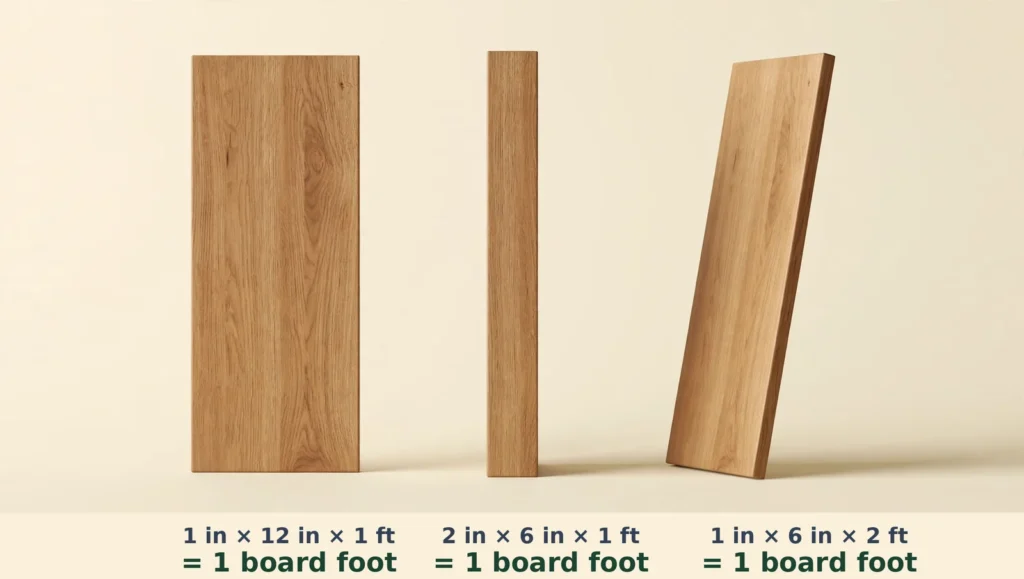
One board foot is the volume of a board 12 inches wide, 12 inches long, and 1 inch thick:
1 board foot = 144 cubic inches = 1/12 of a cubic foot ≈ 2.36 liters
The unit has been used since at least 1834. It lets buyers compare lumber across different widths, thicknesses, and lengths.
These boards all have the same volume:
- 1 in × 12 in × 1 ft = 1 board foot
- 2 in × 6 in × 1 ft = 1 board foot
- 1 in × 6 in × 2 ft = 1 board foot
The dimensions change, but the board-foot count stays the same.
That is also where most confusion starts: people hear “foot” and think length. A board foot is not a length. It is a volume.
Board Feet Measure Volume — Not Length or Area
These units answer different questions at the lumberyard:
| Unit | Measures | Example |
|---|---|---|
| Board foot (BF) | Volume | A 2×4×8 contains 5.33 board feet |
| Linear foot | Length | A 2×4×8 is 8 linear feet long |
| Square foot | Area | A 1×12×8 covers 8 square feet of surface |
A board foot measures how much wood you are buying. A linear foot, also called a lineal foot, measures length. A square foot measures surface area.
Length or area alone cannot tell you the volume of lumber in an order. For a detailed comparison and when to use each unit, see board foot vs linear foot.
The Board Foot Formula (With Worked Examples)
Use this formula:
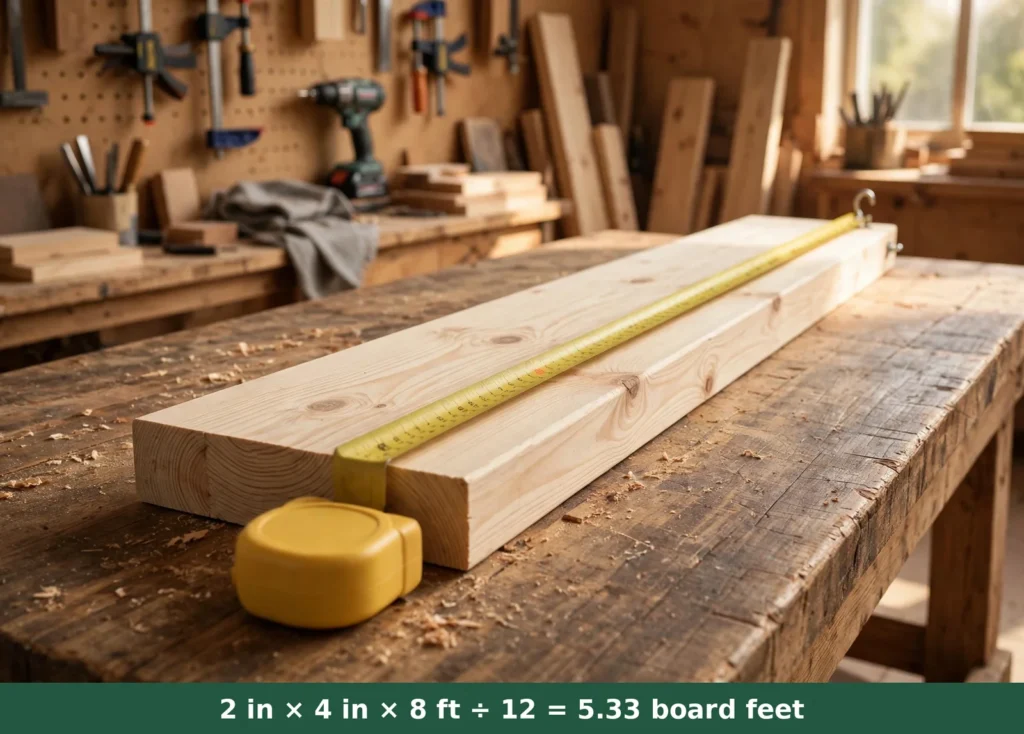
Board feet = (thickness in inches × width in inches × length in feet) ÷ 12
Keep thickness and width in inches and length in feet.
Example: A 2×4×8
(2 × 4 × 8) ÷ 12 = 64 ÷ 12 = 5.33 board feet
Example: A 1×6×10
(1 × 6 × 10) ÷ 12 = 60 ÷ 12 = 5 board feet
Shortcut: The Board Foot Factor
The board foot factor (BFF) lets you calculate the cross-section once, then multiply by length:
BFF = (thickness × width) ÷ 12
Total board feet = BFF × length in feet
A 2×4 has a BFF of 0.667. For an 8-foot 2×4:
0.667 × 8 = 5.33 board feet
This shortcut helps when tallying an order. For a complete order tally and waste allowance, see How to Calculate Board Feet, or use the board foot calculator.
Why Hardwood and Softwood Are Counted Differently
Hardwood and softwood follow different counting rules. A stack can therefore have a different board-foot total depending on the lumber type and measuring method.
| Measurement | Hardwood | Softwood |
|---|---|---|
| Dimensions used | Actual dimensions | Nominal dimensions |
| Thickness | Quarter system: 4/4, 5/4, 6/4, 8/4 | Nominal thickness: a 2×4 counts as 2 in thick |
| Width | Actual width, with surface measure rounded to the nearest foot | Nominal width: a 2×4 counts as 4 in wide |
| Board feet per cubic foot | About 9.5 | About 18.3 |
The theoretical figure is 12 board feet per cubic foot. Hardwood falls below that figure because of rounding and the quarter system. Softwood rises above it because nominal sizes are larger than the actual boards.
Hardwood Example: 600 BF at 4/4 → 900 BF at 6/4
Take 100 boards, each 6.25 inches wide and 12 feet long, at 4/4 thickness, or about 1 inch. Count length in whole feet only; never round it up.
Calculate surface measure as length × width ÷ 12, then round to the nearest foot:
12 × 6.25 ÷ 12 = 6.25, rounded to 6 per board
That gives 600 for the stack. At 4/4 thickness, the total is 600 board feet.
With the same width, length, and board count at 6/4 thickness, or about 1½ inches, the total becomes 900 board feet. That is 50% more board feet without adding boards.
Softwood Example: 100 Pieces of 2×4×10
Using nominal dimensions, surface measure per board is:
4 × 10 ÷ 12 = 3.33
For the stack, that is 333. Multiply by the nominal thickness of 2 to get 666 board feet.
Softwood keeps the fractions, such as 3.33 per board, through the calculation and rounds only after summing the total. The actual board measures just 1½ × 3½ inches.
Retail softwood uses nominal dimensions even after drying and planing reduce the board’s size. The invoice therefore reflects a larger volume than the board physically contains.
Before comparing quotes, ask which counting method the supplier uses. A quote for “600 board feet” depends on that method.

Common Nominal and Actual Lumber Sizes
| Nominal size | Actual size |
|---|---|
| 2×4 | 1½ × 3½ in |
| 2×6 | 1½ × 5½ in |
| 1×12 | ¾ × 11¼ in |
The Quarter System: 4/4, 5/4, 6/4, and 8/4
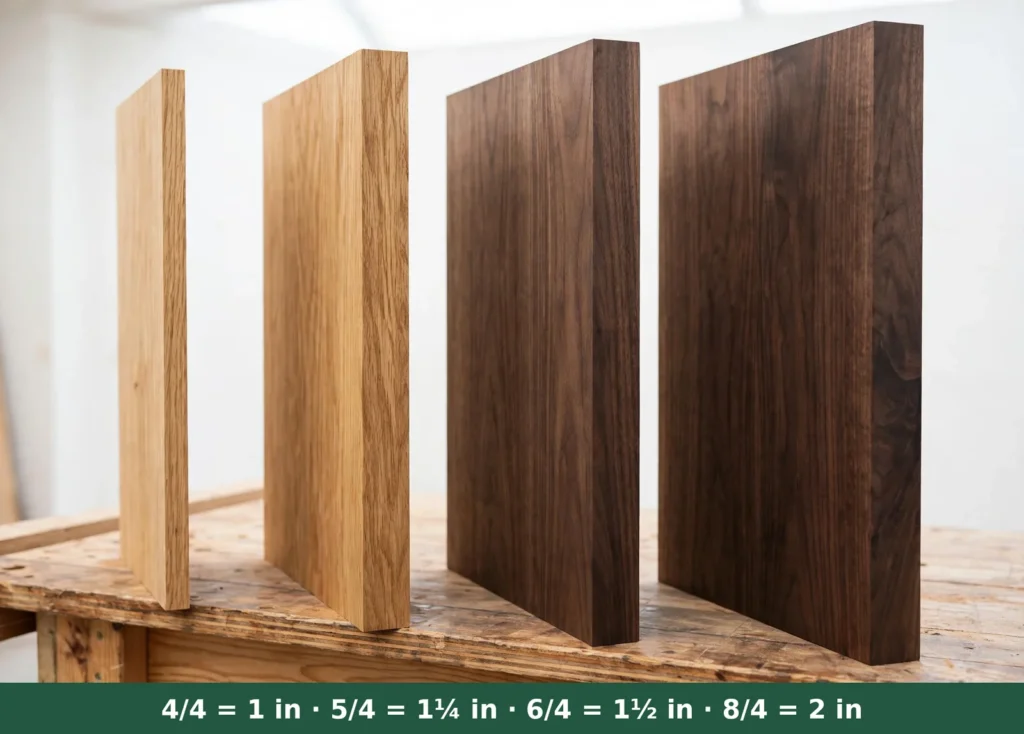
Hardwood thickness uses quarters of an inch. Read 4/4 as “four-quarter” and 5/4 as “five-quarter.” The number before the slash gives the thickness in quarter-inches.
| Mark | Thickness | What it means in practice |
|---|---|---|
| 4/4 | 1 inch | Standard boards; anything under 1 inch still counts as 4/4 |
| 5/4 | 1¼ inches (1.25–1.49 in) | Stair treads, thicker tops |
| 6/4 | 1½ inches (1.50–1.74 in) | Tabletops, workbench tops |
| 8/4 | 2 inches | Legs, turning blanks, heavy tops |
A board thinner than 1 inch still counts as 4/4, so you pay for a full inch of thickness.
The quarter system does not allow for shrinkage. Measurement reflects the board as sawn, before drying and planing.
Kiln-dried boards can be slightly scant and still count at the full quarter mark. The allowance is 1/16 inch for thicknesses under 8/4 and 1/8 inch at 8/4 and thicker.
MBF and Lumber Pricing
MBF means 1,000 board feet. Suppliers may also write it as MFBM or MBFT.
A quote of “$X per MBF” is the per-board-foot price multiplied by 1,000. Mills and large suppliers commonly use this bulk unit.
Hardwood and rough-sawn lumber typically use per-board-foot pricing because the price follows the volume received. Species, grade, and thickness affect the rate.
Our white oak price per board foot guide explains what moves that rate up or down. Our walnut board foot price guide breaks down the premium end of the market.
When Board Feet Is the Wrong Unit
Board feet measure solid lumber. Other products use different units:
- Sheet goods: Plywood, MDF, and OSB sell by the square foot or sheet because thickness is standard and area varies. See board feet to square feet for the conversion.
- Trim, molding, and dowels: These sell by the linear foot because only length varies.
- Logs: A log’s board-foot figure estimates the lumber it will yield; it does not measure the log’s volume. Doyle, Scribner, and International rules produce different estimates. Compare them in Doyle vs Scribner vs International, then see how to calculate board feet in a log for the worked method.
If a seller quotes plywood or trim in board feet, check exactly what the charge covers.
Before You Pay: 3 Checks
You started with a quote you could not verify. These three checks take two minutes and close that gap — run them before you pay any per-board-foot invoice:
- Ask how the lumber was counted. Ask, “Are these board feet nominal or actual—and is this hardwood surface measure or softwood nominal?” You need that answer to compare prices.
- Compare nominal and actual sizes. For softwood, check the invoiced size, such as 2×4, against the actual size you will receive, such as 1½×3½. Know that you are paying for nominal volume before agreeing to the price.
- Round only on the total. Rounding each board’s figure up inflates the order total. Round once, on the final order total, never per board.
Frequently Asked Questions
How many board feet are in a 2×4×8?
A 2×4×8 contains 5.33 board feet: (2 × 4 × 8) ÷ 12 = 5.33. See how many board feet in a 2×4×8 for the full breakdown.
Is a board foot the same as a square foot?
No. A board foot measures volume (144 cubic inches); a square foot measures area. A 1×12 board 1 foot long is 1 board foot and 1 square foot. At 2 inches thick, that same area is 2 board feet but still 1 square foot.
How many board feet are in a cubic foot?
Theoretically, 12. In practice, hardwood works out to about 9.5 board feet per cubic foot and softwood to about 18.3 because of their measuring methods.
What does MBF mean?
MBF means 1,000 board feet, the bulk unit used by mills and large suppliers. A price per MBF equals the per-board-foot price multiplied by 1,000.
What does 4/4 mean in lumber?
4/4 (“four-quarter”) means hardwood is about 1 inch thick; thinner boards still count as 4/4. In the quarter system, 5/4 is 1¼ inches, 6/4 is 1½ inches, and 8/4 is 2 inches.
Do I need board feet for plywood?
No. Plywood and other sheet goods sell by the square foot or sheet. Board feet measure solid lumber only.
Conclusion
What is a board foot? It is 144 cubic inches of lumber volume. To check a quote, you also need the supplier’s measuring rules. Use the formula, confirm nominal versus actual dimensions, and review the count before you pay.
Pingback: How Many Board Feet in a 2x6x8? 8.00 BF Explained
Pingback: How Many Board Feet in a 2x4x12? 8.00 Nominal, 5.25 Actual