
Last updated: November 16, 2026
Sellers lose money at the scale for two common reasons: they measure the big end of the log, or they measure outside the bark. When the buyer’s scaler pulls a tape across the small end inside the bark, the board footage drops and an argument starts that the seller cannot win.
Once you measure correctly and apply the rule the buyer actually uses, the rest of the job is arithmetic. This guide shows you how to measure, pick the rule, calculate, deduct, and tally — in that order — so your scale matches the buyer’s scale.
If you need the finished-board formula instead, see the board foot formula. If you want a single-board calculation, use the board foot calculator.
Quick Answer
Here is how to calculate board feet in a log, in six steps — the same steps a professional scaler uses:
- Measure small-end diameter inside the bark in inches (average two axes on oval logs).
- Measure length in feet, leaving extra inches for trim allowance.
- Agree the log rule before the sale (Doyle, Scribner, or International 1/4-inch).
- Apply the formula (or published table) using diameter (
D) and length (L). - Deduct for defects like rot, splits, sweep, or knots to get net scale.
- Tally per log in net board feet, converting to MBF (1,000 board feet) once at the end.
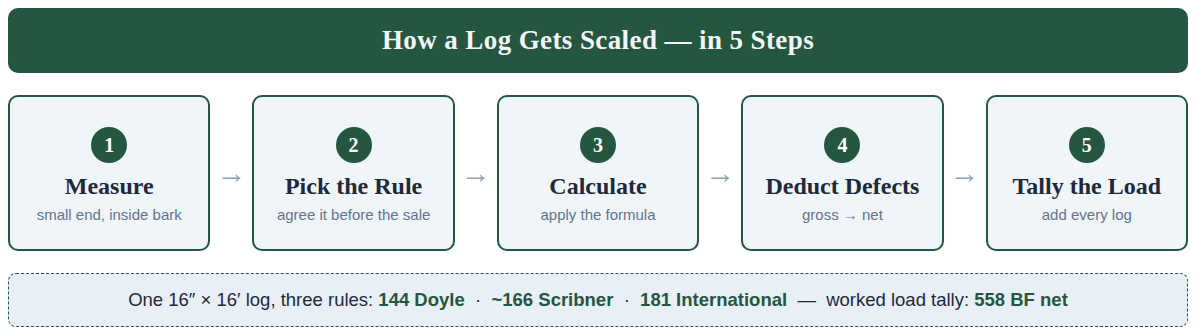
Anchor example: a 16″ × 16′ log equals 144 Doyle / ~166 Scribner / 181 International board feet. It is the exact same log with three different answers — which is why the rule is agreed before calculating.
Prefer to skip the arithmetic? Run any log through our log board foot calculator — all three rules side by side, with defect deduction and a full load tally.
| Log Size | Doyle (BF) | Scribner (BF) | International 1/4-Inch (BF) |
|---|---|---|---|
| 16″ × 16′ | 144 | ~166 | 181 |
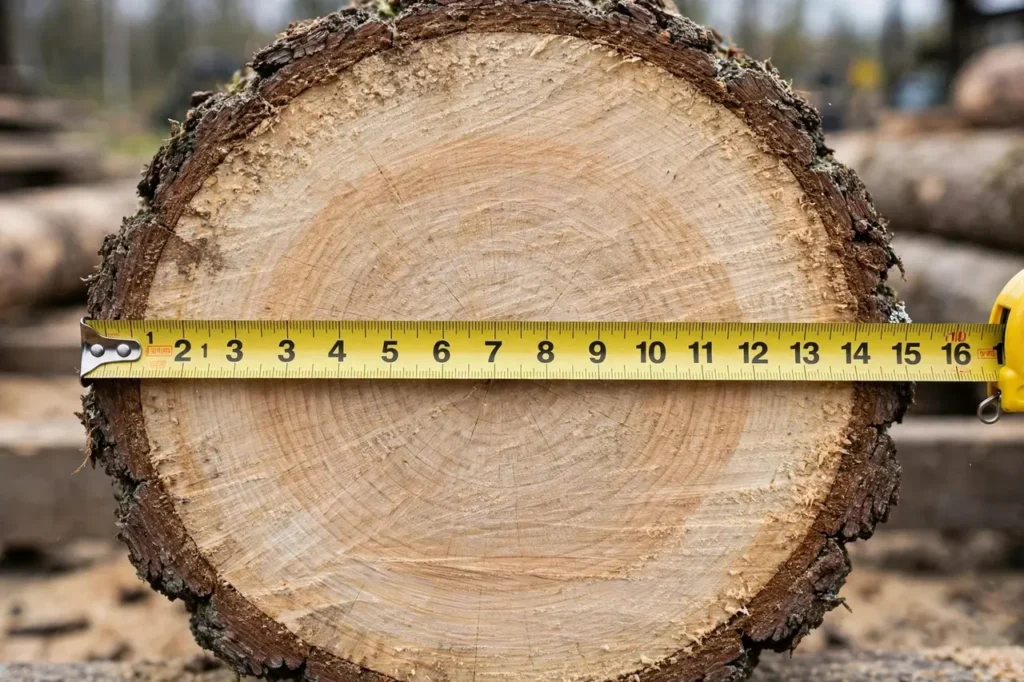
Table of Contents
What You Need
You only need a diameter, a length, and a rule. A tape measure and calculator are enough to work this out — no app or special log scale stick is required.
Do not use the sawn-lumber formula (thickness × width × length ÷ 12) on a round log. The lumber formula measures a rectangular board, not a round, tapered log with bark, slab waste, and saw kerf. It is the most common over-scaling mistake after measuring the big end.
Step 1 — Measure Right
Log rules use small-end diameter (D) in inches and length (L) in feet:
- Small end, not the big end: Log rules scale from the limiting diameter because the narrow end sets the cylinder of full-length boards. The buyer will re-measure the small end anyway.
- Inside the bark: Bark is waste, not lumber. A 16-foot log measuring 17″ outside the bark but holding 16″ of wood changes the Doyle answer by 25 board feet (
169 − 144). - Oval logs: Average the longest and shortest diameters inside the bark. Never pick the bigger one.
- Length in feet: Measure whole feet and leave the mill’s trim allowance so the log is not scaled down.
| Bark Check (16′ Log) | Diameter (D) | Arithmetic | Doyle (BF) | Difference |
|---|---|---|---|---|
| Inside bark | 16″ | (16 − 4)² × 16 ÷ 16 | 144 | Baseline |
| Outside bark | 17″ | (17 − 4)² × 16 ÷ 16 | 169 | +25 BF |
Step 2 — Pick the Rule Before the Sale
Pick the log rule before anyone scales the timber:
- Doyle: The habit in the South and East. Simple math, but it under-scales small logs.
- Scribner: The standard in the West, sitting between Doyle and International on mid-sized timber — and in real sales it is usually read from the Decimal C table, which rounds the scale to the nearest 10 board feet.
- International 1/4-Inch: Tracks actual sawn yield most closely and is used in research and many state sales.
The ~25% gap between rules is where payment disputes come from — agree on the rule before the logs move. For the full comparison, see Doyle vs Scribner vs International log rules. The classic reference behind all three rules is Purdue Extension’s scaling guide, Log and Tree Scaling Techniques (FNR-191).
Step 3 — Calculate Board Feet in a Log
Use small-end diameter (D in inches) and length (L in feet) in your rule’s formula. (For the lumber side of the math, see the board foot formula itself.) Note: the International 1/4-inch formula below is the 16-foot form only. Formulas do not simply ‘work at any length’ — for other lengths, the International scale is built in 4-foot sections or read from published tables.
| Log Rule | Formula (D = small-end diameter in inches, L = length in feet) | Length Scope |
|---|---|---|
| Doyle | BF = (D − 4)² × L ÷ 16 | Scales by L ÷ 16 |
| Scribner | BF = (0.79 × D² − 2D − 4) × L ÷ 16 | Scales by L ÷ 16 |
| International 1/4-Inch (16-ft) | BF = 0.905 × (0.88D² − 1.52D − 1.36) | 16-foot form only (other lengths in 4-ft sections or published tables) |
Worked Arithmetic: 16″ × 16′ Log (D = 16, L = 16)
| Rule | Worked Arithmetic (D = 16, L = 16) | Gross BF |
|---|---|---|
| Doyle | (16 − 4)² × 16 ÷ 16 = 12² × 1 = 144 | 144 |
| Scribner | (0.79 × 16² − 2(16) − 4) × 16 ÷ 16 = (202.24 − 32 − 4) × 1 = 166.24 | ~166 |
| International 1/4-Inch | 0.905 × (0.88 × 16² − 1.52(16) − 1.36) = 0.905 × (225.28 − 24.32 − 1.36) = 0.905 × 199.6 = 180.64 | 181 |
12″ × 16′ Example & Small-Log Pattern
Compare the 12″ × 16′ log, the 10″ × 16′ log, and the 20″ × 16′ log:
Log (D × L) | Doyle Math & BF | Scribner Math & BF | International 1/4-Inch (16-ft) Math & BF |
|---|---|---|---|
| 10″ × 16′ | (10 − 4)² × 1 = 36 | — | 0.905 × (88 − 15.2 − 1.36) = 0.905 × 71.44 = ~65 |
| 12″ × 16′ | (12 − 4)² × 1 = 64 | (0.79 × 144 − 24 − 4) × 1 = ~86 | 0.905 × (126.72 − 18.24 − 1.36) = 0.905 × 107.12 = ~97 |
| 16″ × 16′ | (16 − 4)² × 1 = 144 | (202.24 − 32 − 4) × 1 = ~166 | 0.905 × 199.6 = 181 |
| 20″ × 16′ | — | — | 0.905 × (352 − 1.52(20) − 1.36) = 0.905 × 320.24 = 290 |
A 12″ × 16′ log scales at 64 Doyle, ~86 Scribner, and ~97 International. On a 10″ × 16′ log, Doyle drops to 36 vs International at ~65 — a gap that is small in board feet but wide as a percentage, because Doyle subtracts 4 inches before squaring diameter.
Step 4 — Deduct for Defects
Gross scale is not net scale. Deduct for rot, splits and shakes, sweep or crook, large knots, and metal — as a percentage of gross or by reducing effective diameter or length.
Order of operations: gross first, deduction second, net last. Buyers pay on net scale, so photograph large defects before the sale.
| Log (International Rule) | Gross (BF) | Defect Deduction | Math | Net (BF) |
|---|---|---|---|---|
| 16″ × 16′ Log | 181 | 10% (18 BF) | 181 − 18 | 163 |
Step 5 — Tally a Whole Load
Work each log separately and keep the tally in board feet. Convert to MBF (1 MBF = 1,000 board feet) only once at the end — rounding at every step makes tallies drift.
Here is the three-log tally (181 + (97 − 10) + 290) for three 16-foot logs on the International rule:
| Log | Gross (International) | Deduction | Net |
|---|---|---|---|
| Log 1 (16″ × 16′) | 181 | 0 | 181 |
| Log 2 (12″ × 16′) | 97 | 10 | 87 |
| Log 3 (20″ × 16′) | 290 | 0 | 290 |
| Total (Board Feet) | 568 | 10 | 558 |
| Total (MBF) | 0.568 MBF | 0.010 MBF | 0.558 MBF |
The load scales 568 gross and 558 net board feet (0.558 MBF). Remember, every scale is an estimate: the lumber a log actually yields also depends on its taper, its sweep, and the sawyer’s setup. For milled lumber, use our board foot calculator.
Selling Checklist
Verify these six points before your logs move:
- Rule agreed in writing? Confirm Doyle, Scribner, or International in the contract.
- Diameter measured small-end inside bark? Measure wood-to-wood on the small end and average oval faces.
- Defects noted and photographed? Photograph log ends and visible defects before loading.
- Net scale (not gross) on the ticket? Check that gross, deductions, and payable net scale are listed.
- Price quoted per MBF for that rule’s scale? Match every $/MBF quote to its log rule.
- More than one quote if the load is large? Compare buyer bids on the same scale rule.
Frequently Asked Questions
How do you calculate board feet in a log?
Measure small-end diameter inside the bark in inches (D) and length in feet (L), apply your agreed log rule formula (Doyle, Scribner, or International 1/4-inch) for gross scale, and subtract defect deductions for net board feet.
Which end do you measure?
The small end. Log rules scale from the limiting cylinder of straight boards, and the buyer will re-measure the small end anyway.
Inside or outside the bark?
Inside the bark. Measuring 17″ outside the bark instead of 16″ of wood on a 16-foot log changes the Doyle answer by 25 board feet (169 − 144).
Which rule is most accurate?
The International 1/4-inch rule tracks actual sawn yield most closely because it accounts for a 1/4-inch saw kerf and 4-foot taper sections.
Why do Doyle and International give different answers?
They deduct differently for slab waste, kerf, and taper. Doyle subtracts 4 inches (D − 4) before squaring diameter, creating a ~25% gap on mid-sized logs and a wide gap on small logs (36 Doyle vs ~65 International on a 10″ × 16′ log).
How do you deduct for rot or sweep?
Calculate gross scale first, then subtract the defect as a percentage of gross or by reducing effective diameter or length — a 181 gross BF log with a 10% deduction equals 163 net BF.
How many board feet in a 16 × 16 log?
A 16″ × 16′ log equals 144 board feet on Doyle, ~166 board feet on Scribner, and 181 board feet on International 1/4-inch.
Conclusion
Losing money at the scale starts when a seller measures the big end, includes the bark, or skips the rule conversation until the truck is already loaded. Measure the small end inside the bark, agree on the rule in writing, calculate per log, deduct honestly, and tally in net board feet. The buyer can check every number — and so can you.