
You asked a yard for a walnut board foot price, got a number somewhere between $6 and $22, and now you have no idea whether you were quoted a bargain or a markup. Worse, the boards you budgeted for the table came up short last time — the sticker price was only the start of the bill.
That spread is not the yard being slippery. Walnut is sold at several very different prices at once, and which one you pay depends on grade, surfacing, and where the board comes from. This guide gives you the checked 2026 ranges, the yield math that turns a sticker price into a real price, and worked project budgets — so the quote you accept is the price you planned.
Quick Answer
The walnut board foot price in 2026 is $10–$18 per board foot surfaced (S2S/S4S) at a hardwood dealer and $6–$12 rough-sawn and kiln-dried. A local sawyer’s rough, air-dried stock runs $4–$8. Top-grade FAS 4/4 runs $12–$22 depending on the yard, and figured walnut starts around $20. Prices checked November 2026. Whatever range your quote lands in, add a waste factor before you budget — the worked examples below turn the per-board-foot price into a real project cost.
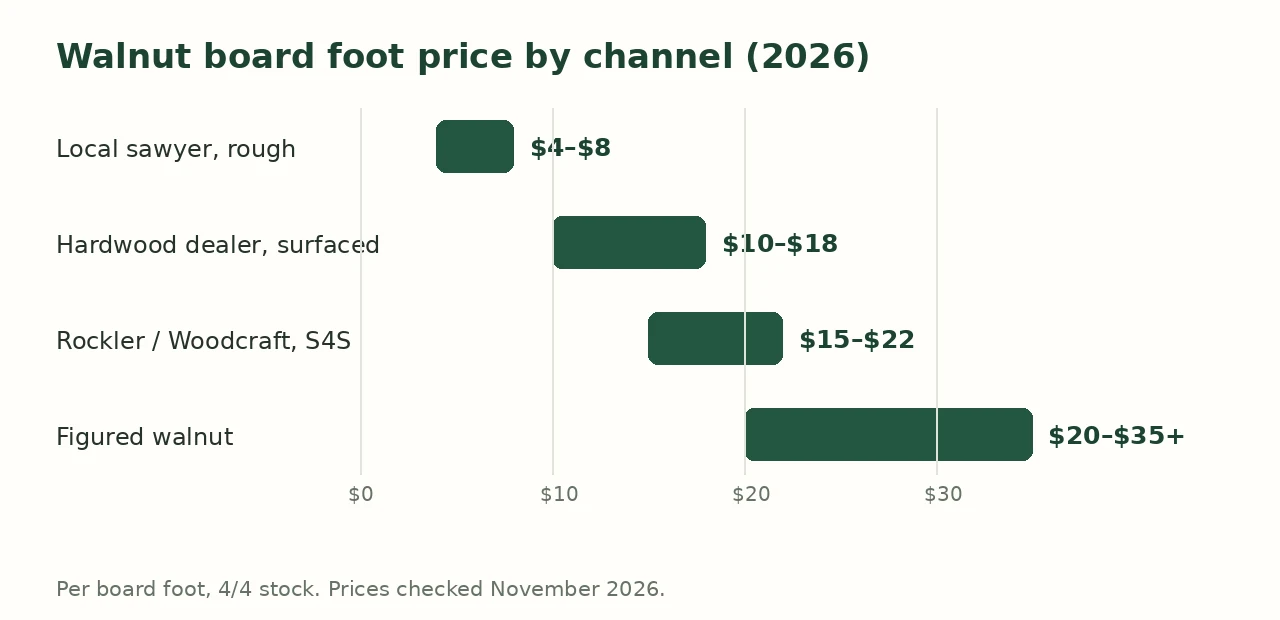
Table of Contents
Walnut Price per Board Foot: 2026 Chart
The 4/4 board is the benchmark — it is what most yards quote and what most furniture projects buy. If the unit itself is new to you, what is a board foot covers the definition in one page; everything below assumes it.
| Form | Price per board foot (2026) | What you get |
|---|---|---|
| Rough-sawn, local sawyer (air-dried or green) | $4–$8 | The cheapest walnut there is; moisture varies and you surface it yourself |
| Rough-sawn, kiln-dried | $6–$12 | Stable and ready to mill — worth it if you own a planer and jointer |
| Surfaced / S2S–S4S, hardwood dealer | $10–$18 | Planed and ready to work; the range most projects actually buy |
| FAS 4/4, kiln-dried | $12–$22 | Top grade; the top of the range is wide, select-quality stock at premium yards |
| Retail chains (Rockler / Woodcraft), S4S by the piece | $15–$22 | Convenience pricing for small, ready-to-use boards |
| Figured (curly, crotch, burl) | $20–$35+ | Priced board by board for the figure, not the volume |
| Live-edge slabs | $15–$35 per board foot equivalent (wide or figured $20–$50+) | Usually priced by the piece — see the slab section below |
Three independent 2026 price guides agree on the two headline ranges — surfaced $10–$18 and rough $6–$12 — which is why they are the ranges to budget against. Where a single yard lands inside them depends on the factors in the next section, and your local yard can sit outside them; the “call your yard” advice at the end is not filler. Industry reporting through 2026 describes the walnut market as stable at historically high levels, so budget on today’s range rather than on a hoped-for price drop.
One contrast that puts the retail price in perspective: the log itself trades for far less. Walnut sawlogs delivered to a mill run roughly $0.35–$1.48 per board foot (Doyle scale), and even veneer-grade logs run $3.12–$8.00 — those are log prices, not lumber prices, and the gap between them and the $10–$18 shelf price is the milling, kiln drying, grading, waste, and retail margin in between. If you are pricing standing timber or logs rather than boards, the log rules work on a completely different basis.
What Moves the Price
Grade. FAS (Firsts and Seconds) is the top grade — the widest, clearest boards — and costs the most. Select & Better sits just below it, #1 Common allows more knots and defects, and #2 Common is the budget grade. Walnut has a grading quirk that matters enough to get its own section below: FAS walnut is graded to a lower clear-wood standard than other hardwoods.
Surfacing. Rough-sawn is straight off the saw. S2S is planed on two faces; S4S is planed smooth on all four sides and is what the retail chains sell by the piece. Each step costs the yard machine time and material, which is why surfaced walnut runs roughly 1.5–2× the rough price from the same supply chain — and why rough only saves you money if you own the machines to surface it yourself.
Thickness. Prices are quoted per board foot, not per board, and thicker stock costs more per board foot, not just per board: 8/4 ties up the kiln longer and yields fewer boards from the same log than 4/4. Always compare quotes at the same thickness — and if an 8/4 quote looks suspiciously close to a yard’s 4/4 price, check what thickness is actually being quoted before you budget around it.
Width and figure. Wide boards cost more per board foot because wide, clear walnut is scarce — the tree branches low, so long wide clear sections are the exception. Figured stock (curly, crotch, burl) leaves the per-board-foot chart behind entirely and is priced board by board.
Region and freight. Black walnut (Juglans nigra) grows across the eastern US, and supply is thickest in the Ohio River basin — Indiana, Ohio, Missouri, Kentucky, Tennessee, and Pennsylvania have the most walnut and the lowest prices. Lumber is heavy: yards on the coasts typically add $1–$3 per board foot in freight, and online orders shipped to the West Coast can add $2–$5 per board foot in shipping alone.
Kiln-dried vs green, steamed vs unsteamed. Kiln-dried stock is stable and ready to work; air-dried and green stock is cheaper because the drying risk moves to you. Most commercial walnut is also steamed after kiln drying, which darkens the pale sapwood toward the heartwood colour for a uniform look. Unsteamed walnut — more common from small mills — keeps richer heartwood tones but a sharp contrast between dark heartwood and pale sapwood. Neither is “better”; they suit different projects, and the choice is covered again under Ways to Pay Less.
Price by Grade — and What You Actually Get Usable
Dealer prices for kiln-dried 4/4, by grade:
| Grade | Price per board foot (2026) | What you actually get |
|---|---|---|
| FAS | $12–$22 | The widest, clearest boards — but read the 67% rule below before you pay for “clear” |
| Select & Better | $10–$14 | Near-FAS quality; the grade most furniture stock is sold as |
| #1 Common | $7–$10 | Sound knots and defects you cut around (graded to 66.7% clear, in smaller cuttings); excellent for small parts |
| #2 Common | $5–$8 | Character grade — visible defects throughout (50% clear minimum); rustic work and short pieces |
The 67% rule — the walnut grade trap. For most hardwoods, a board only grades FAS if at least 83% of it is clear, defect-free wood. Walnut is the exception: because the tree branches low and grows knotty, FAS walnut needs only 67% clear wood. That is not a scam — it is the grading standard — but it surprises buyers who pay FAS money expecting oak-style clear boards and find knots in a third of what they bought. Before you pay the FAS premium for a wide tabletop, look at the actual boards, not the grade stamp.
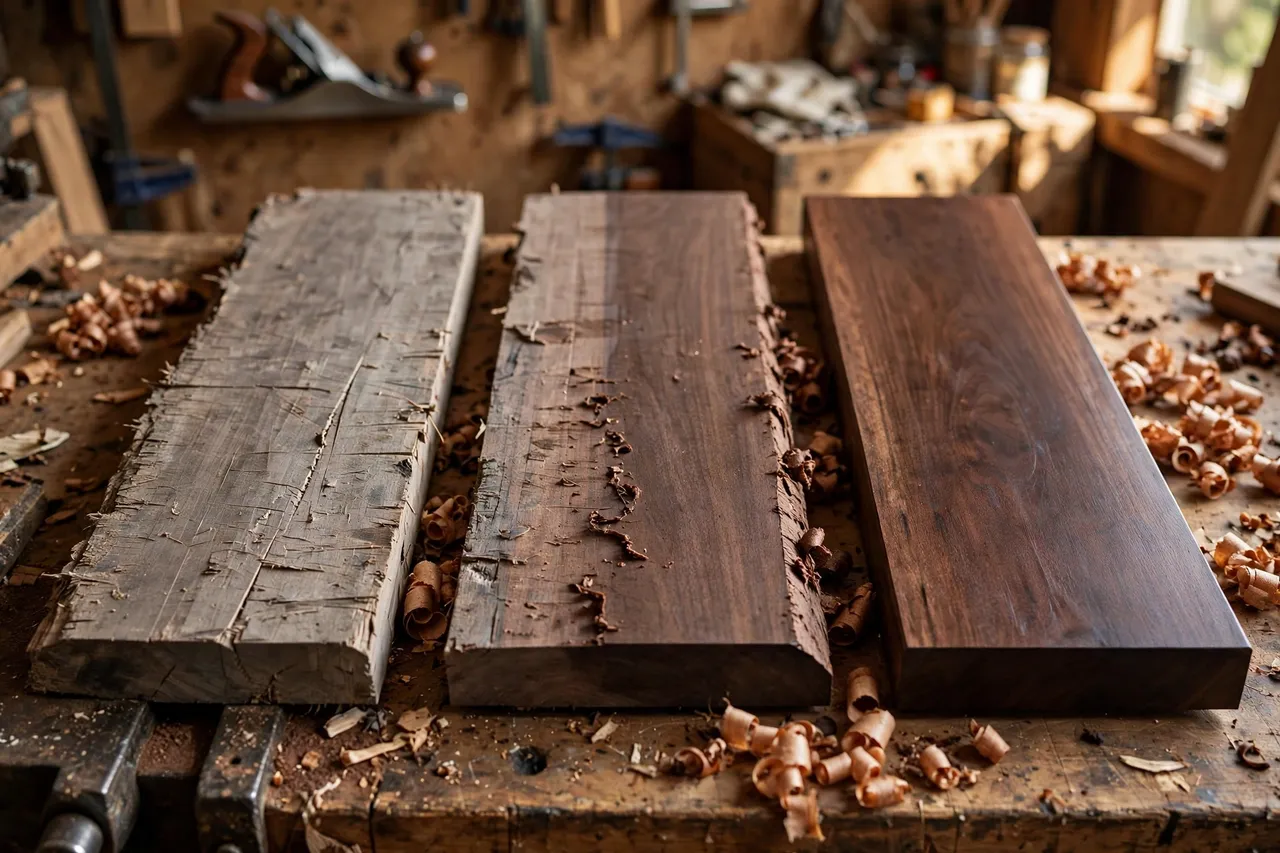
Sticker price vs price per usable board foot. The grade trap has a quieter twin: you pay for the whole board, but you only build with the part of it that survives layout. The honest figure is the price per usable board foot — your sticker price divided by your yield:
| If your yield is… | A $9/bf rough board really costs… |
|---|---|
| 85% (clean stock, simple parts) | $10.59 per usable board foot |
| 75% (standard furniture work) | $12.00 per usable board foot |
| 65% (defects to cut around) | $13.85 per usable board foot |
| 50% (character stock, heavy layout) | $18.00 per usable board foot |
This is why a cheap #2 Common board can end up costing more per usable board foot than Select & Better: the sticker was lower, but half of it went to the offcut bin. It is also why the waste factor below is not padding. Price guides quote a 15–25% waste allowance on rough walnut; our board-foot guide’s project bands run higher for rough stock you mill yourself (25–35%) because they also count the surfacing loss. Use the band that matches how you are buying — and use one of them, every time.
Walnut vs White Oak (and Cherry)
The three premium furniture hardwoods buyers cross-shop most, at surfaced 4/4 prices — the white oak figures are from our own white oak price per board foot guide, so the comparison uses one consistent set of books:
| Species (surfaced 4/4) | Price per board foot | Janka hardness | Why it sits there |
|---|---|---|---|
| Red oak | $4–$7 | 1,290 lbf | Plentiful and easy to work, but not rot-resistant |
| Cherry | $6–$11 | 950 lbf | Warm colour that darkens toward walnut tones with age |
| White oak | $8–$15 | 1,360 lbf | Rot resistance, ray-flake figure, furniture demand |
| Walnut | $10–$18 | 1,010 lbf | The premium dark hardwood — the colour is the product |
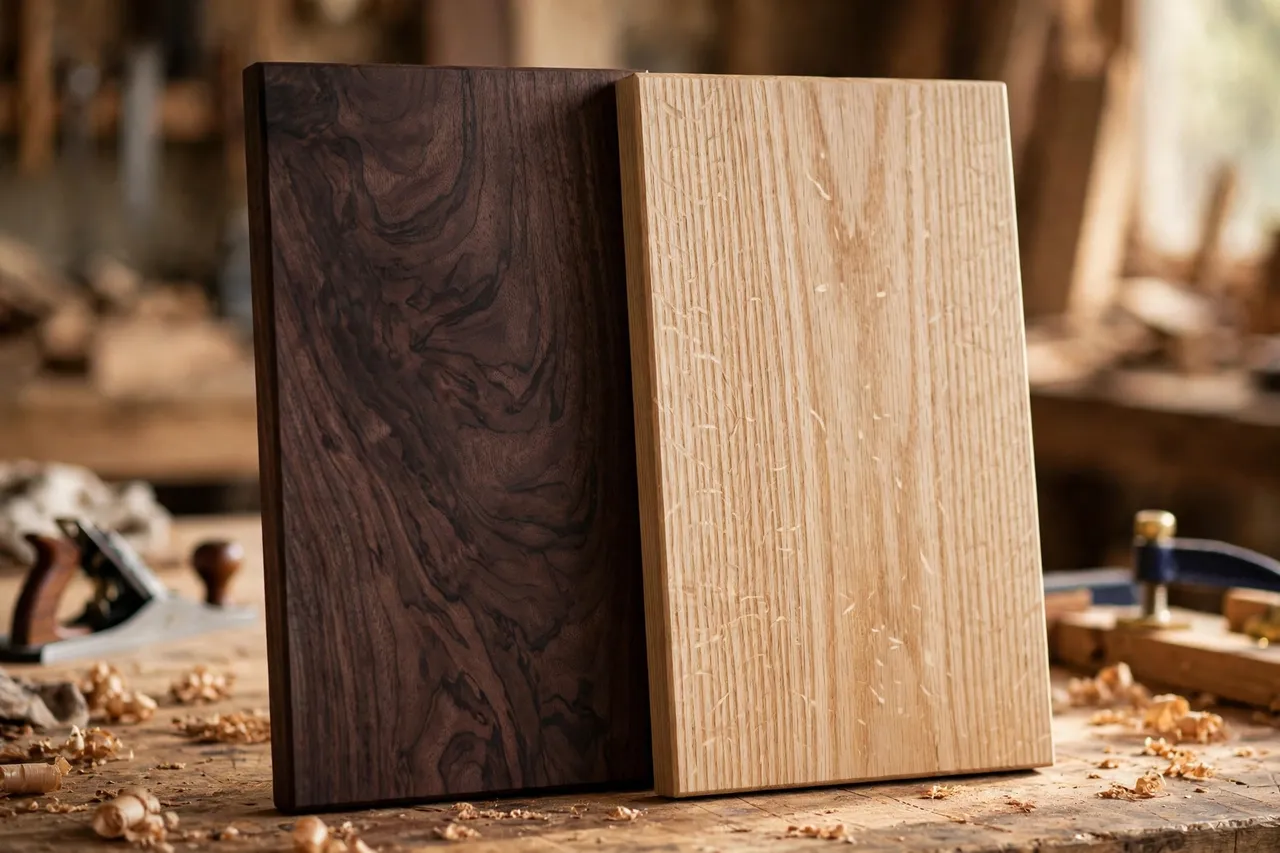
Walnut runs about $2–$3 per board foot above white oak at comparable grade, and it is the most expensive common domestic hardwood. Note what the premium does not buy: hardness. At 1,010 lbf on the Janka scale (USDA Wood Handbook), black walnut is softer than both oaks — it dents more easily, and in exchange it is lighter, stable, and famously easy to work and finish. You are paying for the deep chocolate colour and grain that no stain on oak honestly reproduces.
When walnut is worth it: the dark colour is the design — tabletops, statement furniture, pieces where the wood is the finish. When white oak is the smarter buy: outdoor or moisture-exposed work (walnut is not rot-resistant), high-traffic surfaces that will take dents, and projects where the budget does more work elsewhere. When cherry is the smarter buy: you want a warm dark tone on a smaller budget and can wait — cherry starts lighter than walnut but darkens with age and light, while walnut actually lightens slightly over the years.
Worked Examples: From Price per Board Foot to Project Budget
The formula is simple, and the mistake is skipping the last step:
Project cost = board feet × price per board foot, then add waste.
If you need the underlying math, the board foot formula guide has the full breakdown — and once you know your board feet, run the numbers with our free board foot calculator.
Example 1 — a walnut dining table top. The finished top measures 1.5 in × 36 in × 84 in: (1.5 × 36 × 84) ÷ 144 = 31.5 board feet of finished lumber. At a standard 20% waste factor for furniture work, 31.5 × 1.20 = 37.8 — buy 38 board feet. At $12/bf (Select & Better, surfaced), the top costs 38 × $12 = $456 in material. That is the top only — legs and aprons are on top of it — and it is the number to budget, not the $378 the finished volume alone suggests.
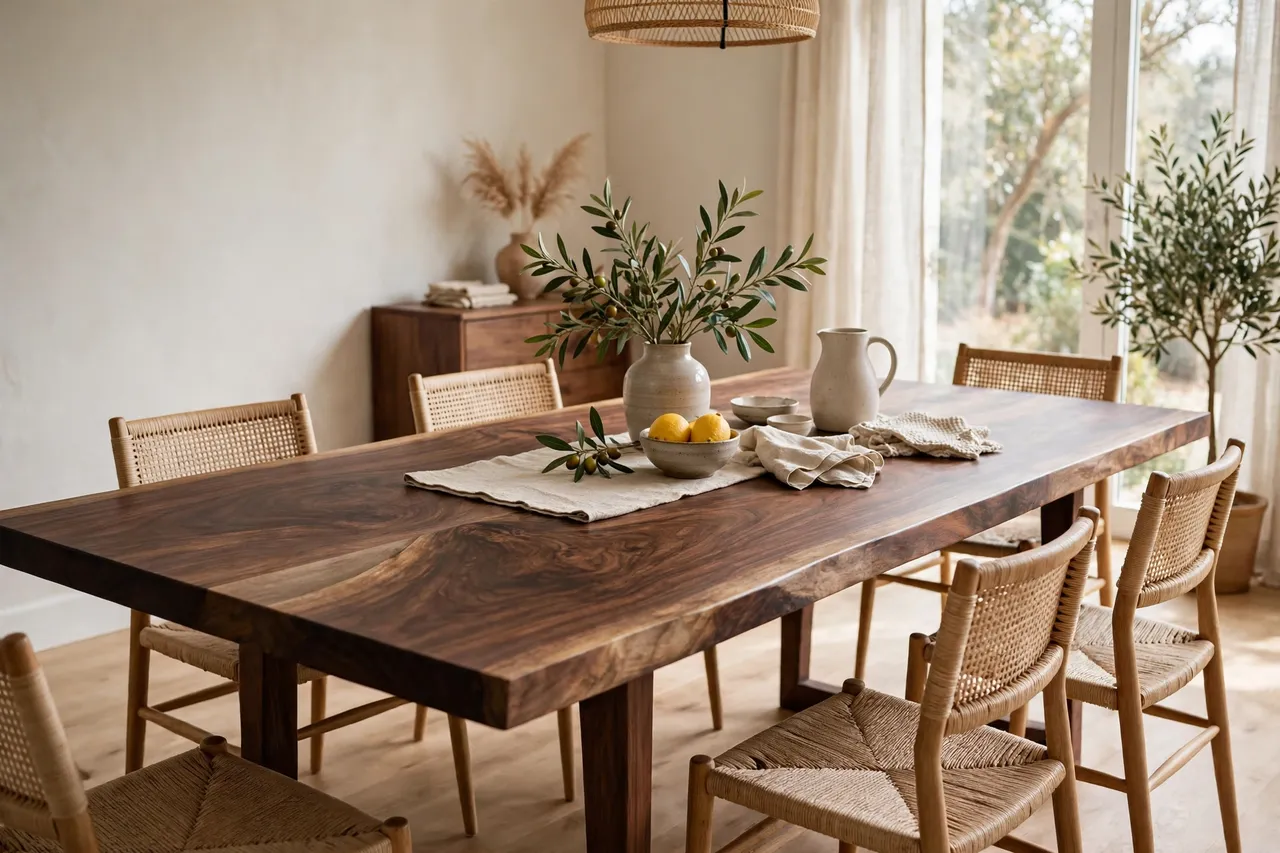
Example 2 — a live-edge walnut slab. A slab at 2 in × 36 in × 84 in works out to (2 × 36 × 84) ÷ 144 = 42 board feet. At $35 per board foot equivalent — the figured/wide end of the slab range — that is 42 × $35 = $1,470 for the slab alone, before flattening, finishing, or legs. The slab section below explains why slabs are quoted by the piece even though the board-foot math still works as a sanity check.
Example 3 — a small project, priced honestly. A keepsake box or cutting board needs about 3 board feet finished. Add 25% waste for small parts cut around defects: 3 × 1.25 = 3.75 — buy 4 board feet. At $12/bf surfaced, that is $48. From the shorts rack at the usual 20–30% discount, the same 4 board feet runs roughly $34–$38. Small walnut projects are where the grade and channel choices move the bill the most, percentage-wise.
Slabs: When the Board-Foot Price Stops Applying
Live-edge walnut slabs are usually priced by the piece, not by the board foot — the width, figure, and character of that specific slab set the price, and two slabs of identical volume can differ by hundreds of dollars. Typical per-piece prices by project size:
| Slab project | Typical slab dimensions | Typical price per piece |
|---|---|---|
| Charcuterie / serving board | Under 18 in wide, under 24 in long | $50–$200 |
| Coffee table | 20–36 in wide, 48–72 in long | $300–$800 |
| Dining table | 30–48 in wide, 96–120 in long | $500–$2,000+ |
| Exceptional figured slab | Wide, thick, rare grain | $2,000–$10,000+ |
As a board-foot equivalent, typical pricing works out to $15–$35 per board foot equivalent, with wide or figured slabs at $20–$50+. Use the board foot formula on a slab anyway: it is the fastest sanity check on a per-piece quote. If a slab’s price works out to $60 per board foot equivalent, you should be able to see why — exceptional width, figure, or both.
Budget the rest of the slab project honestly, too: professional flattening and finishing typically add roughly $100–$400 on top of the slab price, and a green or air-dried slab that is not yet stable can move after you buy it — ask about kiln drying before anything else. And if a seller quotes you a slab by the linear foot instead, that is a different unit entirely — see board foot vs linear foot before you compare the number to anything in this guide.
Ways to Pay Less for Walnut
- Check the shorts rack first. Yards routinely discount short boards 20–30%. For boxes, cutting boards, drawer parts, and stretchers, shorts are the same walnut at a lower walnut board foot price — Example 3 above is built on them.
- Match the grade to the parts list. Small parts cut from short clear sections do not need FAS. #1 Common at $7–$10 — laid out with five minutes of care — beats FAS pricing on almost any small-parts project, and on walnut the trick works better than on other species: since even FAS walnut is only graded to 67% clear, the practical gap between FAS and #1 Common is smaller than the price gap suggests.
- Buy rough-sawn only if you own the machines. The $6–$12 rough range is real money saved if you have a planer and jointer. Without them, surfacing charges and extra waste hand the discount back — buy S2S and pay for one planed face and edge instead.
- Buy closer to the saw. In the walnut belt (IN, OH, MO, KY, TN, PA), local sawyers sell rough air-dried walnut at $4–$8. You take on the drying and surfacing; the freight and retail margins come out of your price.
- Choose steamed vs unsteamed on looks, not habit. Steamed stock gives uniform colour across a wide glued-up top. Unsteamed keeps richer heartwood contrast — often the better-looking board for smaller pieces, and small-mill unsteamed stock skips some of the commercial processing built into dealer prices.
- Buy the whole project at once. One tally, one trip: boards from the same lift match in colour, and you are not paying small-order pricing three times.
Where to Buy, and What to Ask the Yard
| Channel | Typical walnut price | The trade-off |
|---|---|---|
| Local sawyer / small mill | $4–$8 rough, air-dried | Cheapest; you dry, surface, and grade it yourself |
| Hardwood dealer / lumber yard | $10–$18 surfaced, $6–$12 rough KD | Graded, kiln-dried, pick your boards — the default for furniture |
| Online hardwood dealer | Dealer range + shipping (West Coast +$2–$5/bf) | Wide and figured stock you cannot find locally; you cannot hand-pick |
| Rockler / Woodcraft | $15–$22 S4S, by the piece | Ready-to-use small boards at convenience prices |
| Marketplace / odd lots | Varies widely | Estate and shop-clearance bargains — and every red flag below, unchecked |
Before you pay, ask four questions:
- Kiln-dried? Air-dried and green stock still moves — and it should run roughly 20–30% below kiln-dried prices for the same grade. If the price looks like the kiln-dried range but the stock is air-dried, you are overpaying.
- What grade — and is that the grade on the invoice? The classic red flag is #1 Common sold at an FAS price. On walnut, where FAS itself means 67% clear, the board in front of you matters more than the stamp.
- Rough, S2S, or S4S? It changes both the price and the thickness you actually get — a planed 4/4 board is 3/4 in thick but was still a 4/4 board at the saw. Surfacing legitimately adds roughly $2–$4 per board foot over rough; a much larger surfacing premium is markup.
- Is any of it figured? Figured boards priced as standard are a bargain; standard boards priced as figured are the opposite.
More red flags: green or air-dried stock priced as kiln-dried — if a “kiln-dried” price sits at the very bottom of the rough range, ask when it came out of the kiln — and “walnut” with no chocolate-brown heartwood in sight; check the end grain before you pay walnut money for a board that may not be walnut at all.
And the honest caveat that applies to every price in this guide: call your local yard before you commit. A checked national range gets you to a realistic budget; only the yard’s quote gets you to a purchase.
Frequently Asked Questions
How much does walnut cost per board foot?
Surfaced walnut (S2S/S4S) runs $10–$18 per board foot at hardwood dealers in 2026, and rough-sawn kiln-dried runs $6–$12. A local sawyer’s air-dried rough stock runs $4–$8, FAS 4/4 runs $12–$22, and figured walnut starts around $20. Prices checked November 2026; your yard’s quote is the final word.
Why is walnut so expensive?
Supply and yield. Black walnut grows across the eastern US but branches low, so clear, wide boards are a small fraction of each log — small enough that the grading rules themselves were relaxed for the species (FAS walnut needs only 67% clear wood, versus 83% for most hardwoods). Add strong furniture demand for a dark hardwood no other domestic species matches, export demand from Europe and Asia competing for the same logs, plus kiln drying and steaming, and the price follows.
Is walnut more expensive than oak?
Yes. Walnut runs $10–$18 per board foot surfaced, against white oak’s $8–$15 and red oak’s $4–$7. Walnut is the most expensive common domestic hardwood — and, at 1,010 lbf Janka, it is actually softer than both oaks, so the premium buys colour and workability, not hardness.
What is a fair price for rough walnut?
Kiln-dried rough-sawn walnut at $6–$12 per board foot is the fair 2026 range. Air-dried or green stock from a local sawyer at $4–$8 is fair for what it is — as long as it is not priced as kiln-dried. Above $12 for rough, you should be getting FAS grade, exceptional width, or figure.
How much walnut do I need for a dining table?
For the top alone, a 36 in × 84 in top at 1.5 in thick is 31.5 board feet finished; with a 20% waste factor you buy 38 board feet — $456 at $12/bf. Legs, aprons, and breadboard ends are additional. Run your own dimensions through the board foot calculator before you order.
Steamed or unsteamed walnut — which should I buy?
Steamed, if you are gluing up a wide top and want one uniform dark colour across every board — steaming darkens the pale sapwood toward the heartwood. Unsteamed, if you want the richer natural heartwood tones and do not mind a visible pale sapwood edge, or if you are trimming the sapwood off anyway.
How much does a walnut slab cost?
Slabs are priced by the piece, typically working out to $15–$35 per board foot equivalent, and $20–$50+ for wide or figured pieces. A 2 in × 36 in × 84 in slab is 42 board feet, so at $35 per board foot equivalent it prices at $1,470 — before flattening and finishing, which typically add $100–$400.
Conclusion
The walnut board foot price in 2026 is $10–$18 surfaced and $6–$12 rough-sawn — but the sticker is only the start of what you pay. Budget with the waste factor in, divide by your realistic yield to get the price per usable board foot, and check the grade against the board in front of you — remembering that FAS walnut is graded to 67% clear, not 83%. Do that, and the quote that looked like a markup (or a bargain) turns into the price you planned: no short boards mid-project, and no surprise second trip to the yard.